What Is Property Styling and Why Does It Matter in Sydney’s Property Market?

Sydney’s median house price now exceeds $1.4 million. At that figure, buyers are not browsing casually. They are comparing competing listings in seconds, online, before they commit to a single inspection.
Research consistently shows buyers eliminate the majority of listings based on photographs before stepping inside one. The properties that win inspections are not always the strongest on paper. They are the ones that stop the scroll, photograph with presence, and trigger emotional commitment before any negotiation starts.
Leave your home unstyled in Sydney’s current market and you hand the competitive edge to vendors who spent a fraction of your property’s value on furniture, art, and professional presentation. You can price correctly, market aggressively, and still watch a listing stall that should have sold.
This article defines what property styling is, explains how it works, shows which rooms carry the most commercial weight, and gives you a clear-eyed view of the cost-to-return equation in Sydney’s specific market conditions.
What Property Styling Actually Is
Property styling, called home staging in American markets, is the process of preparing a residential property for sale by furnishing, decorating, and presenting each room to maximize its perceived value. A professional stylist selects furniture, art, soft furnishings, and accessories calibrated to the property’s price point, target buyer demographic, and floor plan.
The goal is not to reflect the seller’s taste. It is to reflect the buyer’s aspiration. That distinction drives every decision, from sofa scale to the height of a bedside lamp.
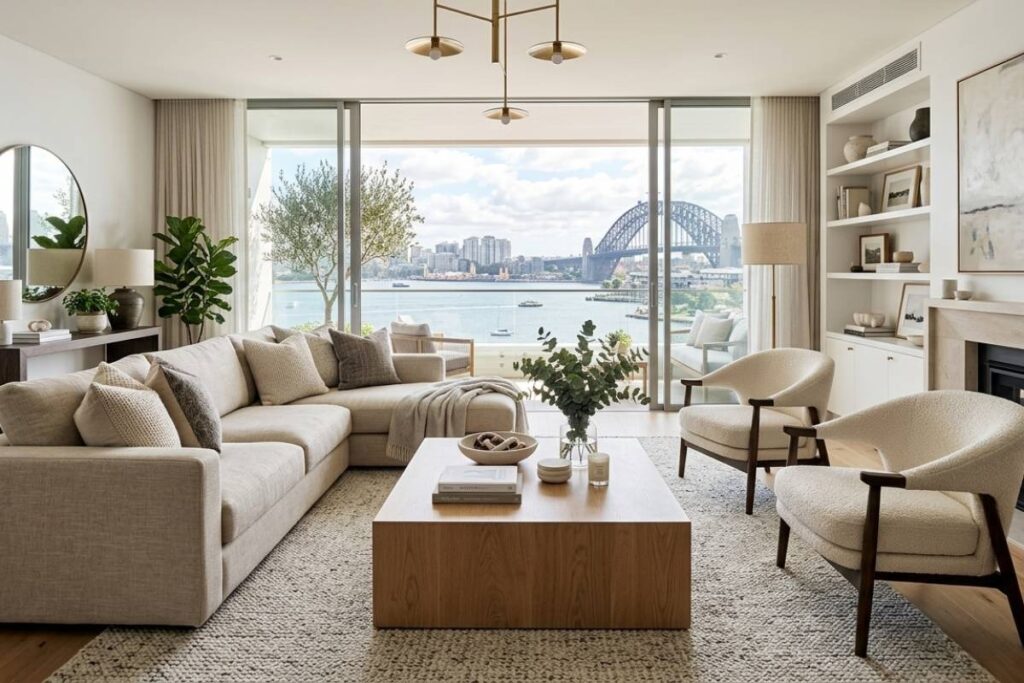
Property styling operates across three service tiers: consultation-only (the stylist advises; the vendor executes), partial styling (key rooms only), and full styling (every room furnished and dressed for the campaign period).
Property Styling vs. Interior Design
Interior design serves the occupant. Property styling serves the sale. Interior designers work over months to embed a client’s personality into a space. Property stylists work within days to create a neutral, aspirational aesthetic that resonates with the broadest possible buyer pool.
Interior design choices are permanent. Styling is temporary. The stylist’s furniture and accessories are removed when the campaign ends.
The core tactical difference: interior designers personalize; property stylists depersonalize. Removing family photographs, replacing niche furniture with proportionally scaled pieces, and eliminating occupant-specific decor all reduce buyer friction and make it easier for a stranger to imagine owning the home.
The distinction matters commercially: for a deeper breakdown of where the disciplines diverge, the differences between interior design vs interior decoration clarify why the two serve fundamentally different purposes.
Why Sydney’s Market Amplifies the Impact
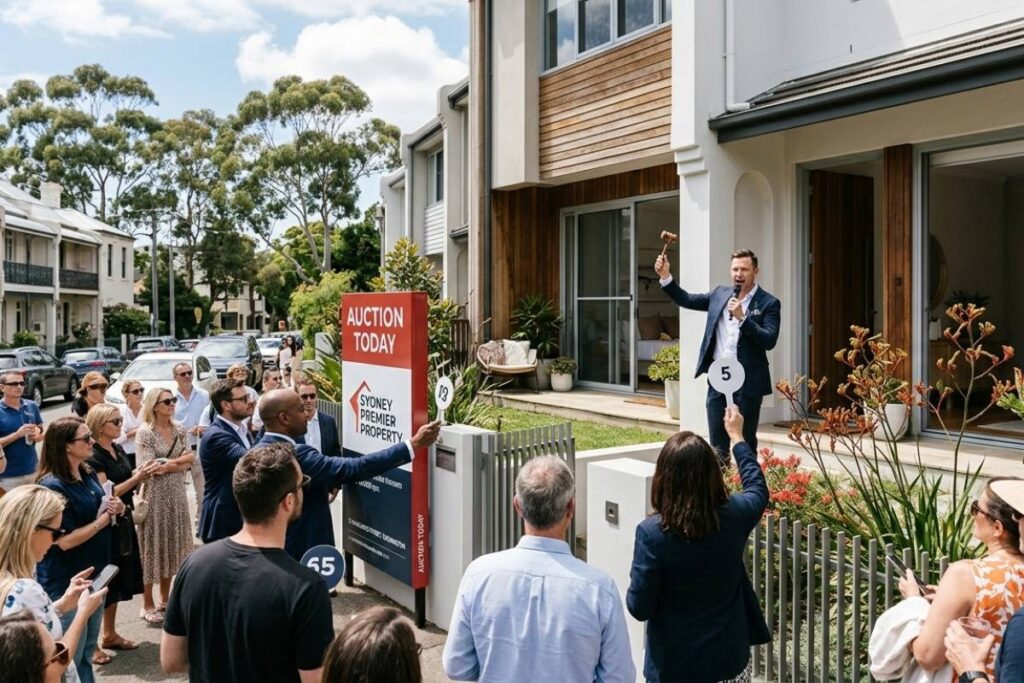
Sydney runs on auctions. The auction format compresses an emotional and financial decision into a single high-pressure moment. Buyers who have spent weeks mentally inhabiting a property arrive at auction with higher emotional commitment, and committed buyers bid harder.
Domain and realestate.com.au listings receive the majority of their lifetime traffic within the first 72 hours of going live. Photography from a professionally styled property generates a stronger click-through response than unstaged photography, which directly increases inspection numbers.
Sydney’s price band also amplifies the arithmetic. A 1% lift on a $1.4 million property equals $14,000. The average full styling campaign costs between $4,000 and $10,000. That ratio warrants serious consideration before a vendor dismisses the outlay as unnecessary.
What a Property Stylist Does
Before entering your property, an experienced Creative Property Stylist reviews the agent’s price guide, the target buyer demographic, and comparable sales in the suburb. They approach the brief as a positioning exercise within a specific buyer market, not as a decorating project.
On-site, the stylist assesses existing furniture and advises what to remove, what to keep, and what to replace. They work with the floor plan and natural light to determine furniture scale, traffic flow, and how each room reads in a wide-angle photograph.
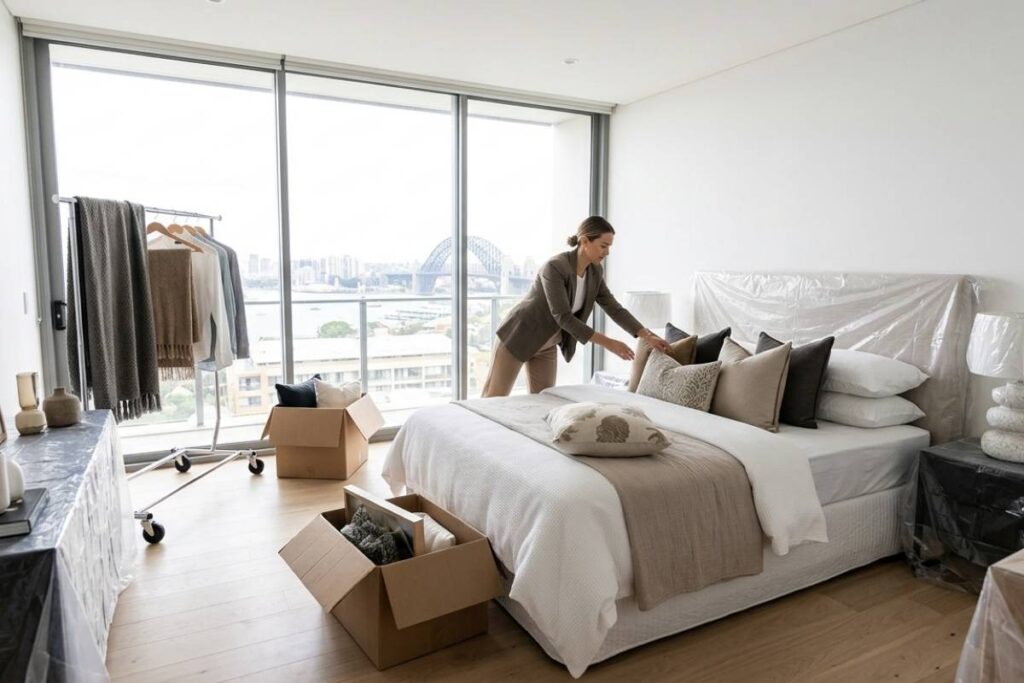
The stylist then sources and delivers rental furniture, art, rugs, cushions, throws, plants, and accessories from their inventory. The stylist installs everything, dresses each space, and confirms readiness before the photographer arrives, typically within one to two days.
Which Rooms Deliver the Most Impact
The living room
Set the tone for the entire property. Buyers form their initial perception of size, lifestyle, and quality within the first seconds of entering this space. Correctly scaled furniture, layered lighting, and a well-chosen art piece signal the property’s aspiration without crowding the room.
The master bedroom
Sell the lifestyle promise. Buyers, particularly couples making a joint decision, want to see themselves in this space. Crisp hotel-style bedding, bedside symmetry, and neutral soft furnishings work across demographics because they project calm and quality without demanding a specific taste.
The kitchen and dining area
Function as the social centre of most Australian homes. Buyers assess both the physical space and its felt quality. A bowl of fruit at the bench, a set of cookbooks, and one plant at the counter line can make a functional kitchen read as genuinely desirable without a dollar spent on renovation.
How Styling Affects Sale Price and Time on Market
The commercial case for property styling is well-documented. According to the 2025 Profile of Home Staging published by the National Association of Realtors (NAR), 83% of buyers’ agents confirmed that staging a home makes it easier for buyers to visualize the property as their future home, and more than a quarter of real estate professionals reported that staging their sellers’ homes netted between 1% and 10% more in sale price compared to non-staged equivalents.
While this data originates in the US market, Australian agents and property stylists consistently report comparable outcomes in Sydney campaigns, particularly in the $1 million to $3 million price band where buyer competition is most concentrated.
The table below shows how styling affects the key commercial variables at each stage of a Sydney sales campaign:
| Metric | Professionally Styled | Unstyled |
| Online listing click-through | Higher; professional photography converts better | Lower; empty or cluttered rooms reduce engagement |
| Inspection attendance | Increased by strong online first impression | Reduced; buyers screen properties out before visiting |
| Days on market | Shorter; stronger initial demand accelerates decisions | Extends as the buyer pool narrows over time |
| Buyer emotional engagement | High; aspirational spaces trigger faster commitment | Low; buyers must work harder to visualize the home |
| Negotiation leverage | Vendor holds stronger position with competing interest | Buyers negotiate harder from a lower opening offer |
| Price achieved vs. price guide | More likely to meet or exceed guide | More likely to sell at or below guide |
How Much Does Property Styling Cost in Sydney?
Full property styling in Sydney typically ranges from $4,000 to $10,000 for a standard three-bedroom home, depending on property size, campaign length, and the number of rooms furnished. Larger prestige properties in the $3 million to $5 million price bracket can run to $15,000 or higher.
Consultation-only services start from around $300 to $600. Partial styling of key rooms (living area, master bedroom, dining room) sits between $2,500 and $6,000. The standard campaign period is 28 to 42 days, with additional monthly rental fees applying if the property takes longer to sell.
Cost varies based on the depth of the stylist’s furniture inventory, their track record in your suburb’s specific price bracket, and whether professional photography staging is included as part of the service.
Is It Worth It?
Run the arithmetic. On a $1.4 million Sydney property, a 1% increase in sale price equals $14,000. A full styling campaign costs, at most, $10,000. The net position in that scenario is $4,000 ahead, before accounting for the reduced holding costs that come with fewer days on market.
The stronger argument, however, is risk management. In Sydney’s listing environment, an unstyled property competing on the same street as a styled one carries a visible disadvantage. Buyers review both online before they see either in person. Presentation shapes perceived value before a single buyer walks through the front door.
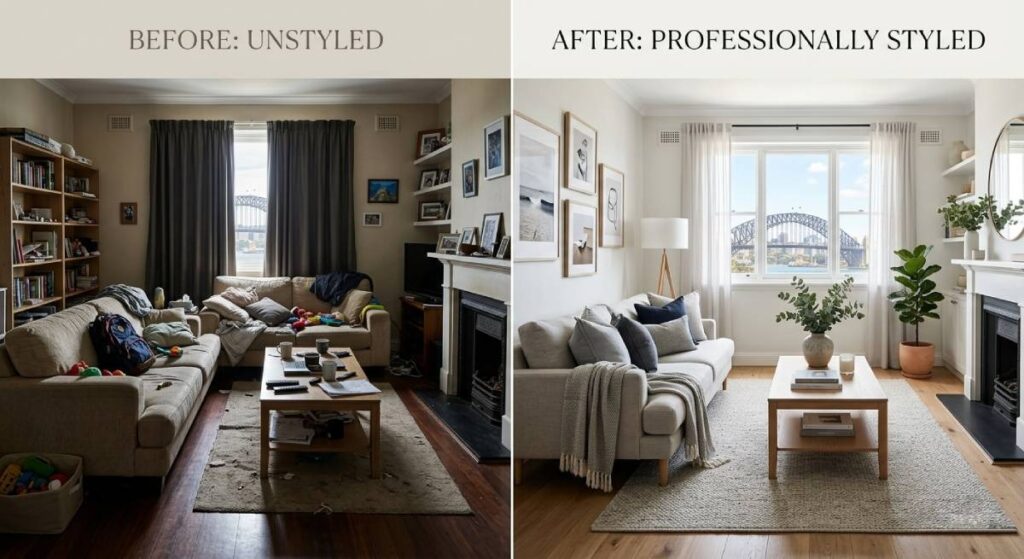
Property styling works best when combined with professional photography, a well-timed campaign launch, and an agent with verifiable sales history in your suburb. Styling does not rescue a mispriced or poorly marketed property. It does, reliably, raise the ceiling on what a correctly priced and well-run campaign achieves.
Conclusion
Property styling is a commercially focused sales tool that reshapes how buyers perceive and value a home before any negotiation begins. In Sydney’s high-stakes, auction-driven, photography-first market, it delivers measurable advantages in online engagement, inspection numbers, and final sale price. Vendors who treat presentation as optional leave a quantifiable gap between what their property sells for and what a professionally styled campaign could have achieved.